
Human Trafficking Survivors Honored as Graduates of Court Specialized Docket
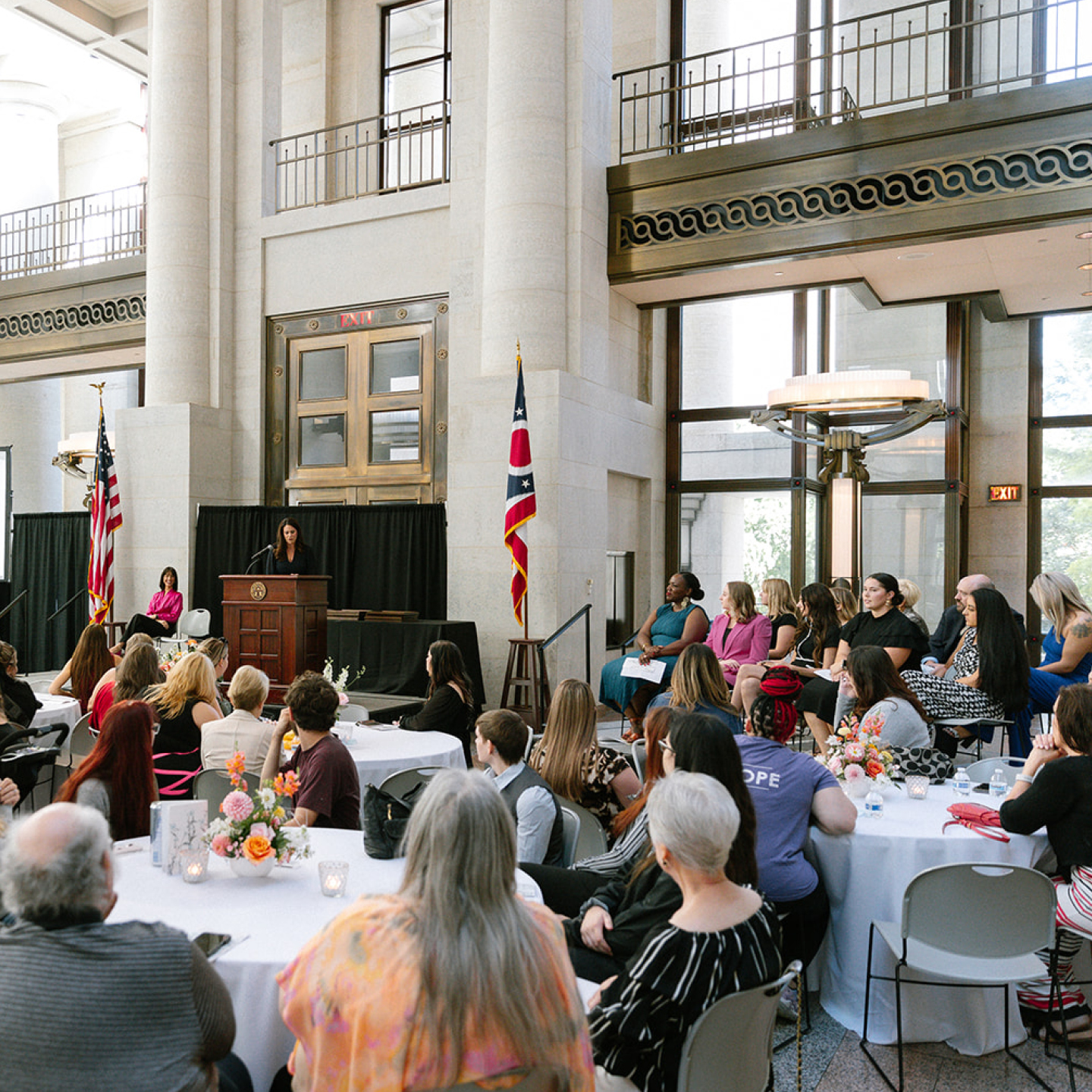
The Franklin County Municipal Court held a celebration at the Ohio Statehouse to honor new graduates of a human trafficking specialized docket.
A recent ceremony celebrating 15 new graduates of a specialized docket in Franklin County Municipal Court showcased their stories and the crucial support from the court treatment teams.
The graduates completed a two-year specialized docket program called CATCH Court, which stands for “Creating Autonomy Through Collaborative Healing.” It is one of five specialized dockets the municipal court offers as an alternative to incarceration for people working to overcome the challenges that brought them into the criminal justice system. The specialized docket for CATCH Court focuses on victims of human trafficking who are also dealing with substance use disorders.
In a graduation announcement, the court noted that the graduates explained that their abusers fed their growing drug addiction to keep them compliant and unable to flee for years as new criminal charges repeatedly landed them in court. The court stated that the support of strangers, from community groups and inside the court, repeatedly made the difference for the 15 women who survived the sexual exploitation of human trafficking. The help started with temporary assistance that became transformative when coupled with the specialized docket program, which has helped hundreds of women recover and provided continuing emotional support, the court said.
Two of the 15 women graduates sought initial help at Sanctuary Night, a nonprofit that meets basic needs and provides a supportive community. The women were assisted by two previous specialized docket graduates who encouraged them to learn about the court’s program, the court noted.
Another woman was already a participant in the specialized docket when she got involved with the workforce development program at Freedom a la Cart, a local café and catering kitchen that has a long relationship with the court. In the program, survivors with six months of sobriety can receive paid training and personal support while employed there.
The court also described a fourth woman who found encouragement after dropping out twice from the specialized docket. This time, a pregnancy and wanting to provide the best for her child motivated her to stay in the program, the court noted.
Specialized Docket Part of State’s Innovative Efforts
Participants in the specialized docket are on probation, undergo counseling, and meet with the docket’s presiding Judge Jodi L. Thomas and her staff each week. The program is one of more than 200 certified specialized docket programs in Ohio. These dockets address substance use and mental health disorders among adults and children involved in the justice system. Some programs serve a broad range of participants, while others focus on specific groups in need, such as veterans, those affected by domestic violence or human trafficking, or individuals reentering their communities after incarceration.
To be certified, each court must adopt the Supreme Court’s research-based standards. Courts then tailor their dockets to the needs of their communities and participants. The goal is to serve individuals who need the most help and who demonstrate the highest risk of returning to the justice system. By treating the underlying causes of behavior rather than relying solely on punitive measures, specialized dockets help participants break harmful patterns and avoid future contact with courts, jail, or prison.
An array of information and resources about Ohio’s specialized dockets is available from the Supreme Court. Among the materials are a map of the specialized dockets to help Ohioans locate programs in their area and guidance to local courts on certifications, best practices, and training opportunities.
Courts are encouraged to share news of events, initiatives, programs, and other announcements with Court News Ohio. Ideas can be submitted to CNO@sc.ohio.gov.