
More Data About Ohio Court Cases Accessible in Expanded Dashboards
New features improve transparency, simplify navigation, and provide deeper insights into caseload trends
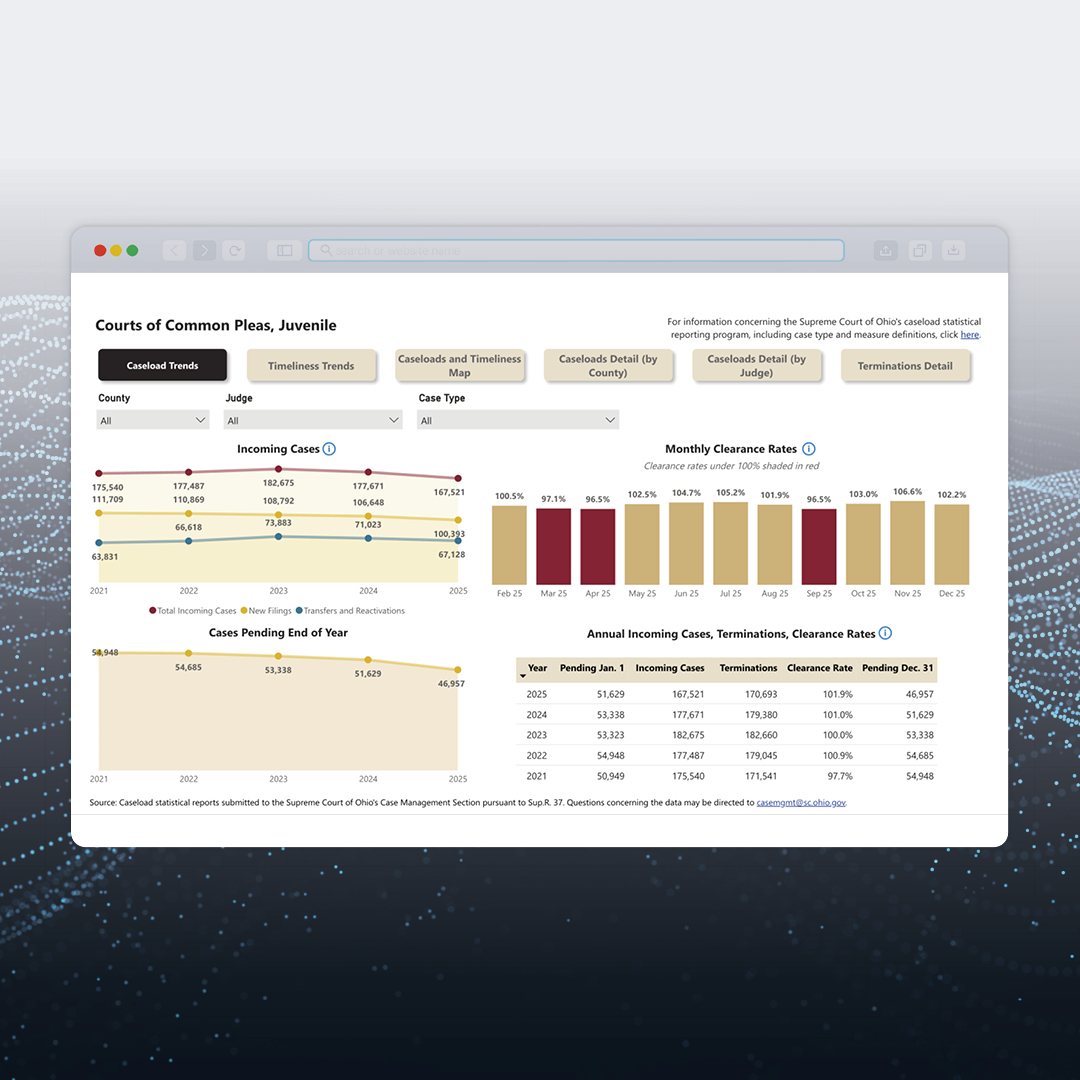
Upgrades to Ohio court data dashboards give more insights about cases and caseload trends.
Interactive dashboards that produce visual data on cases and caseloads from courts across the state have been enhanced by the Supreme Court of Ohio.
Judges in Ohio courts of appeals, common pleas courts, municipal courts, and county courts are required to report statistics and case processing timelines to the Supreme Court Case Management Section. The interactive dashboards, available on the Supreme Court website, transform these complex statistics into informative graphics and tables to assist the public, news media, and courts.
To modernize the dashboards and expand the information available about court operations, the Supreme Court implemented several improvements, including:
- A common layout framework across the dashboards that is designed to be more easily understood without reading FAQs or other instructions.
- A new key performance indicator for courts – the “on-time rate” – which measures the number of cases pending at the end of each month that are on track to be resolved within state guidelines. Green icons in the Caseloads Detail tab show when a court or judge is aligned with the Supreme Court’s performance target of resolving 95% of most case types within the applicable time standard.
- Additional navigation buttons that allow visitors to easily move from high-level overviews of courts (general division, juvenile, etc.) to details about individual courts and judges.
- More intuitive ways to filter the data, such as by county, judge, and case type (criminal, civil, workers’ compensation, and others).
- On-screen hovering definitions explaining various data measures – including clearance rates, on-time rates, and over-age cases – tracked in the dashboards.
- Features that allow visitors to easily compare data across courts, such as common pleas general division, juvenile, domestic relations, and probate courts.
- More graphs to illustrate data trends over time.
Another innovation is a single, streamlined dashboard for municipal and county courts, which previously were presented as separate dashboards – one for the entire court and another for individual judges. A new dashboard for Ohio appellate courts has also been launched.
The enhanced dashboards offer additional ways to slice and dice the data, broadening the transparency into information about state courts. For example, data on caseloads and case timeliness can now be broken down by county or by judge, making specific details simpler to access. With the Caseloads Detail by Judge button, all of the judges within a specific type of court can be viewed and compared on one screen. Using the Caseloads and Timeliness Map, visitors can sort by different “divisional configurations” – meaning courts with a separate juvenile division, courts that combine juvenile and domestic relations divisions, those that combine juvenile and probate divisions, and the other combinations found in the state’s common pleas courts.
Along with these improvements, the dashboards for municipal, county, common pleas, domestic relations, juvenile, and probate courts continue to provide insights into caseload trends, such as the number of cases filed and pending at the end of each year, dating back 10 years. The probate court dashboard also includes a button to view the number of marriage applications granted since 2016.
Like the other court dashboards, the new appeals court dashboard presents caseload and case timeliness data. It also offers basic information about each of the state’s 12 appellate districts, including the number of judges and counties in each district.
These powerful enhanced dashboards and the increased transparency into data about case processing are part of a broader initiative led by Chief Justice Sharon L. Kennedy to provide judges with timely information to monitor and improve case management and reduce court backlogs.