
Supporting and Improving Legal Representation for Those Who Can’t Afford It
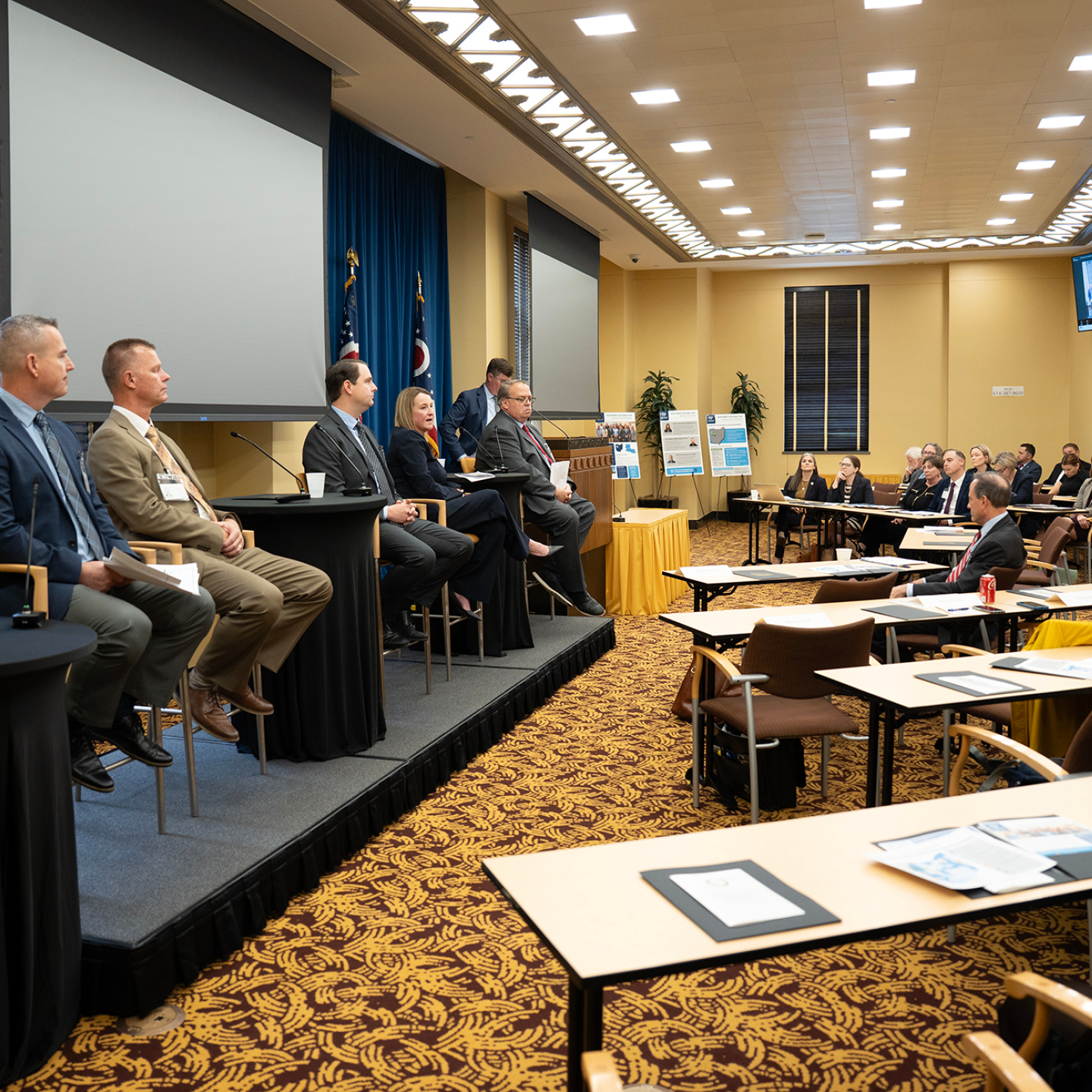
Judges, public defense leaders, and county officials discuss ideas for ensuring the right to an attorney in Ohio.
People who can’t afford an attorney have a constitutional right to effective legal representation in certain types of cases, most notably criminal. In Ohio, attorneys are provided through a public defender’s office, a nonprofit organization, a court appointment, or a blend of these approaches.
Ohio Public Defender Elizabeth Miller explained that each Ohio county makes its own decision about how to provide the needed legal representation to people. At a recent symposium on the state’s indigent defense system, Miller noted that this locally driven structure in Ohio has struggled to meet the demand for qualified attorneys to represent individuals and has largely looked the same for the last half century
“But what we all know is that not only has the practice of law evolved, but the people who are doing the work have also changed over time,” she said at the event, hosted by the Supreme Court of Ohio.
The changes are extensive, spanning from evolutions in technology that affect the types and complexity of evidence in criminal cases to the obstacles law school graduates confront when making career choices while carrying substantial education debt. Given the challenges, judges, attorneys, public defense leaders, and county officials explored what’s working and what can be improved for indigent defense in the state.
Judges Highlight Challenges for Rural Counties
Currently, every one of Ohio’s 88 counties depends on a court-approved list of private attorneys for appointments to represent people who can’t afford an attorney, Miller noted. In most counties, court-appointed counsel options overlap with legal representation from the Ohio Public Defender’s Office, county public defender offices, and nonprofits such as legal aid organizations to meet the need. In 36 Ohio counties, though, court appointments are the only source of legal representation for people who are indigent.
Judge Keith H. Schierloh of the Putnam County Common Pleas Court noted that his rural county has historically relied on private practice attorneys from Toledo, two counties to the north, to serve as court-appointed counsel for indigent defendants. Judge Schierloh said the attorneys had to drive 60 miles one way to do their work in Putnam County, which has a population of about 30,000. That commute meant the attorneys couldn’t be at the courthouse every day, causing problems for the court in scheduling cases and requiring it to try to stack sets of hearings together on certain days based on the attorneys in the case, he said.
“It made it difficult for us to provide individuals with good counsel who would be available to meet with them on a day-to-day basis,” he said.
Southeast of Putnam County, Judge Andrew R. Tudor of the Hardin County Municipal Court encountered similar challenges. He noted that the rural county, also with 30,000 residents, has a good list of attorneys available for court appointments. But none live or work inside Hardin County.
“We have drawn attorneys from Bowling Green, Franklin County, Champaign County – all an hour away,” he said.
Regional Public Defender Office Offers Approach That’s Working
Enter the Northwest Regional Hub, launched last year. Allen County Commissioner Cory Noonan said the idea built on the success of the public defender’s office created in his county in 2021. State reimbursement rates for attorneys doing indigent defense also rose about that time, and Noonan said there was an opportunity for Allen County to join with Putnam and Hardin counties to expand efficiencies and cost effectiveness for providing counsel.
The Northwest Regional Hub is a public defender office that is funded and managed through the Ohio Public Defender’s Office and serves clients across all three counties. Judges Schierloh and Tudor have seen substantial benefits from the program. The regional hub’s public defenders who are assigned to provide legal representation in their counties are readily available for court hearings. And the public defenders can regularly meet with clients, answer their questions, and make informed, up-to-date decisions for them during hearings, Judge Schierloh explained. Courts in the county still need to assign private attorneys to some cases, but the regional hub has expanded the attorneys available who can assist clients in the three counties.
The Northwest Regional Hub also provides more than public defenders for each county. It has a social work assistant who can identify needed services for clients and investigators who can examine crime scenes, interview witnesses, and testify in court.
Noonan believes the regional hub approach is the model for ensuring the right to counsel for those who are indigent in rural areas.
“I think it truly is a beacon of what can and should be provided for individuals,” he said.
Ideas to Enhance Court Appointments of Attorneys
Another path Miller outlined for improving indigent defense is giving additional support to the court-appointed system used to assign counsel where needed.
“If we don’t add more resources to the system, people aren’t going to want to do the work,” she said.
Miller described a framework proposed by her office for a central infrastructure in Ohio to better support assigned counsel. As one step, Miller would like to compile a statewide roster of assigned counsel that judges could use to make assignments. She noted that this roster could include important information, such as an attorney’s willingness to mentor newer colleagues or travel to specific counties to take cases. It would function as a supplement to the local lists courts have in each county, she noted.
Miller also pointed out that current law allows counties to set the pay rates for assigned counsel, and those rates can vary up or down from the state rate of pay established for the assignments. She suggested that legislation to ensure every county pays counsel at the state rate is needed to overcome “justice by jurisdiction,” where attorneys are drawn to assignments in counties that pay more. In addition, the office envisions expanding its “strike force” team of attorneys, who have expertise in complex litigation involving high-level felonies or death penalty charges, to assist appointed counsel with the toughest cases in their counties.
Qualifications for Appointed Counsel Considered
The presenters and the audience also debated whether the current minimum qualifications for reimbursing appointed counsel for their work need an adjustment to expand the attorney pool, particularly for rural areas.
The state public defender’s office recommends maintaining the existing minimum qualifications to support effective assistance of counsel by appointed attorneys. After investigating the concerns and forming an informational subcommittee, the nine-member Ohio Public Defender Commission concluded that lowering minimum qualifications is unlikely to address the attorney shortages in rural counties. However, lowering minimum qualifications could impact the quality of counsel that people receive, the commission determined.
The Ohio State Bar Association presented other viewpoints on the qualifications. Matthew Oyster, the association’s chief of staff and general counsel, said the group has been considering whether the minimum qualifications measure attorney competency in the best ways and give trained attorneys a realistic route into court-appointed work. The association is examining what matters to ensure that court-appointed attorneys are prepared, and it seeks a flexible system that offers additional, alternative paths for attorneys to take on appointments, Oyster said. He emphasized that the association supports options to meet the demands of the attorney shortage in Ohio without compromising the competency of legal representation for indigent defendants.