Longtime Judge and Virtual Self-Help Centers Receive Awards for Excellence and Innovation
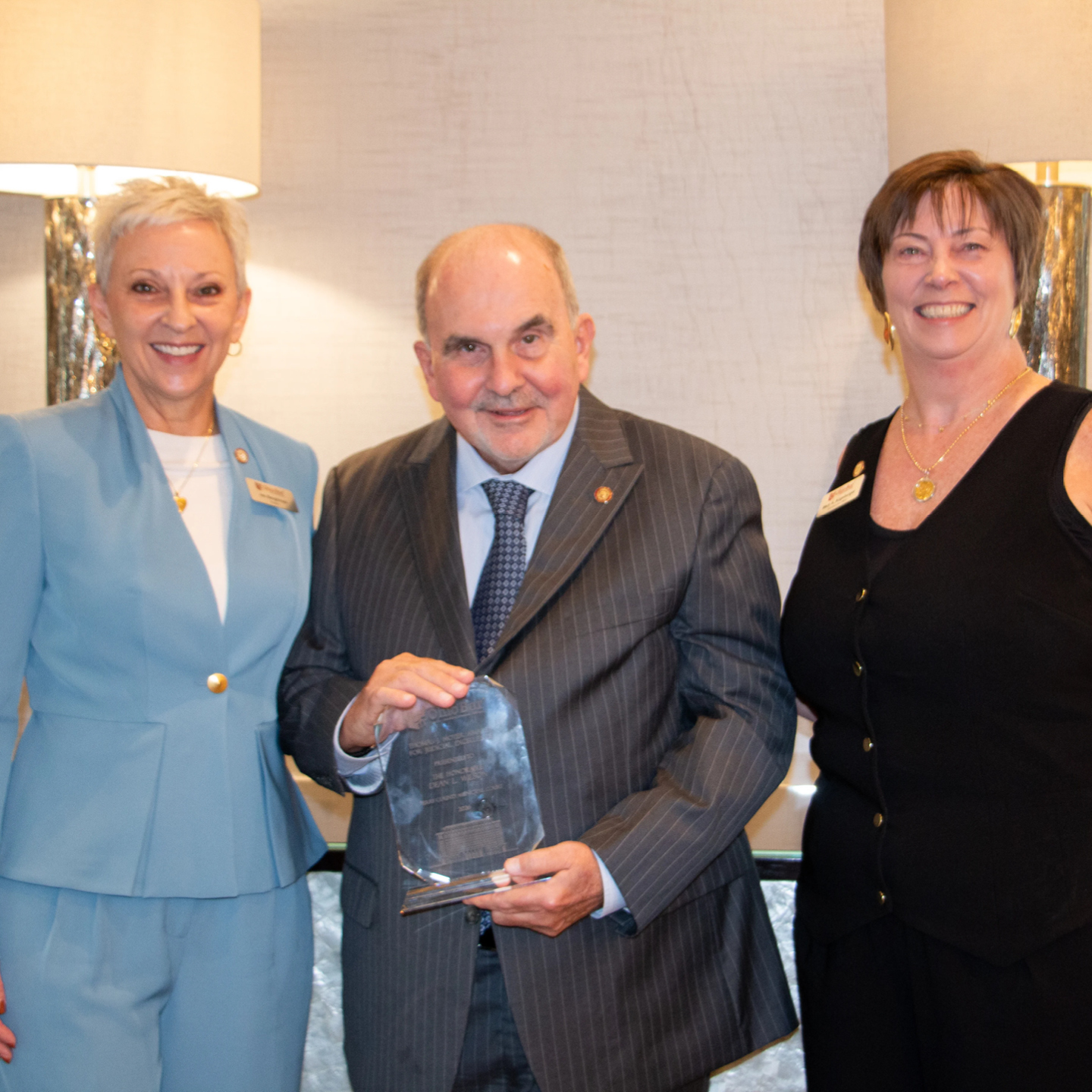
Ohio State Bar Association President Jan Allen Baughman (left) and Ohio Bar CEO Mary Amos Augsburger (right) honored retired Judge Dean Wilson with the Moyer Award.
A longtime Perry County Municipal Court judge was presented with the Thomas J. Moyer Award for Judicial Excellence last week at the Ohio Judicial Conference annual meeting.
The Ohio State Bar Association presented the Moyer Award this year to retired Judge Dean Wilson. The bar association noted in an announcement that the award was established in honor of late Supreme Court of Ohio Chief Justice Thomas J. Moyer to recognize a judge “in the Moyer mold,” who displays outstanding qualities of judicial excellence, including integrity, fairness, open-mindedness, knowledge of the law, professionalism, ethics, creativity, sound judgment, courage, and decisiveness.
The bar association also gave an Innovative Court Programs and Practices Award to three courts in Cuyahoga, Lorain, and Montgomery counties. The courts worked in conjunction with the technology nonprofit Ohio Legal Help to establish virtual self-help centers to make going to court easier for the public.
Moyer Award for Judicial Excellence
Judge Wilson served the people of Perry County for 33 years on the Perry County Court and Perry County Municipal Court. Throughout his career, the judge demonstrated an unwavering commitment to justice and to his community, the bar association announcement stated. It described his judicial philosophy as grounded in accessibility, dignity, and the belief that courts must evolve to meet the needs of the communities they serve.
The bar association also identified the Perry County New Directions Drug Court as one of the judge’s most impactful contributions. It is a specialized docket he envisioned, developed, and implemented in response to the growing substance-use crisis in rural Ohio. Recognizing the community costs of addiction, the judge convened an advisory committee in 2015, studied best practices, and built a program tailored to the unique needs of Perry County. Launched in 2016, the New Directions Drug Court embodies the principles of accountability, compassion, and evidence-based intervention, the bar association stated. It highlighted the 81% participant success rate under the judge’s leadership and the consistent reports from participants that they felt seen, respected, and supported in the program.
The bar association also pointed out retired Judge Wilson’s statewide leadership in expanding the public understanding of and access to the courts. He has championed driver’s license reinstatement programs that remove barriers to employment and stability. And as the 2022-2023 Ohio State Bar Association president, he worked as a steadfast advocate to support access to attorneys for clients in underserved areas, the bar association stated. In his retirement, he continues to give back through assignments as a visiting judge in courts across the state.
“Judge Wilson has a profound love for the people of his county, the state of Ohio, and the legal profession,” bar association President Jan Allen Baughman said at the awards ceremony. “For decades, he has shown a commitment to fairness, innovation, and principled judicial service where everyone is treated with dignity and respect – all hallmarks of a great jurist. Judge Wilson has been an inspiration to me and countless others, and I am proud to recognize him with the Moyer Award this year.”
Moyer served as the Supreme Court of Ohio chief justice for more than two decades. During his tenure, he ushered in a wave of modernization and reform, with leadership that extended well beyond the courtroom and reshaped how Ohio’s courts functioned. Moyer took office as chief justice in January 1987 and served in the role until his death in 2010. He was the second longest serving chief justice in Ohio history.
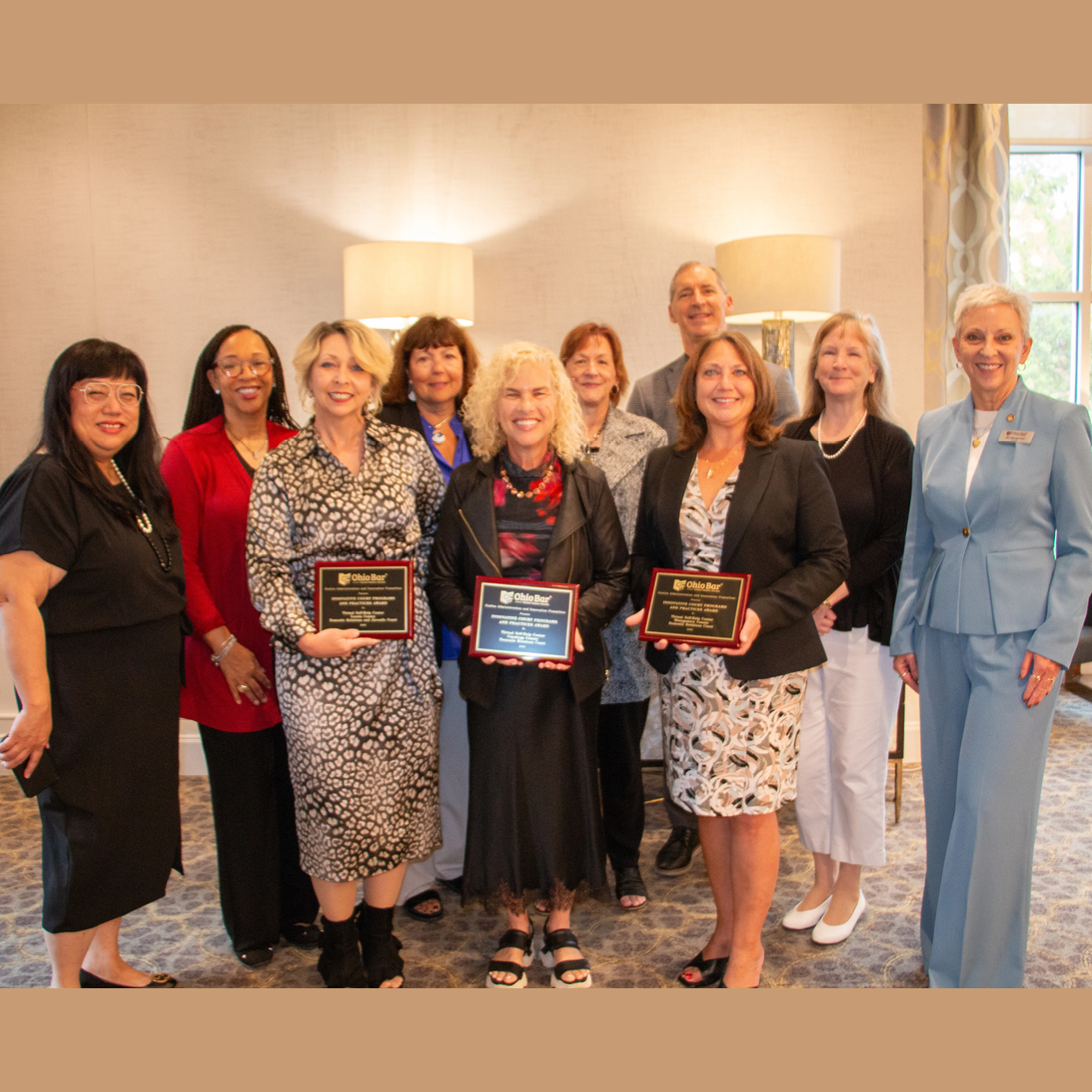
Three courts received the 2026 Innovative Court Programs and Practices Award. Pictured (from left): Ohio Legal Help Executive Director Susan Choe, Judge Tonya Jones (Cuyahoga County), Judge Sherry Glass (Lorain County), Judge Diane Palos (Cuyahoga County), Judge Francine Goldberg (Cuyahoga County), Judge Pamela Hawkins (Cuyahoga County), Judge Frank Janik (Lorain County), Judge Jennifer Petrella (Montgomery County), Judge Lisa Swenski (Lorain County), and Ohio Bar President Jan Allen Baughman.
Innovative Court Programs and Practices Award
The Innovative Court Programs and Practices Award, sponsored by the bar association’s Justice Administration and Innovation Committee, seeks to highlight and bring greater visibility to exemplary programs in Ohio’s courts and to facilitate the transfer of those programs to other jurisdictions. Recognized this year for their virtual self-help centers were the Cuyahoga County Domestic Relations Court, the Lorain County Domestic Relations and Juvenile Court, and the Montgomery County Domestic Relations Court.
Virtual self-help centers provide critical court information and allow users to fill out, edit, save, and complete court forms directly from their mobile phones or computers in matters such as divorce, child custody, and protection orders. The centers also offer support through an automated chatbot, which can help with navigation, answer commonly asked questions, and walk users through the forms they need to complete.
This effective use of technology to modernize court services makes navigating the court system less intimidating and more accessible, particularly for people who otherwise would need to arrange travel, childcare, and time off from work to go to court, the bar association explained. The platform also encourages and helps users to connect with an attorney for assistance with their legal problems.
To date, the bar association noted, more than 93,000 users have been assisted with legal information and procedural questions via the virtual self-help centers. More than 30,000 users have found assistance with court forms. And more than 80% of users rate their experience as positive and helpful. Most people using the platforms have incomes at or below 200% of the federal poverty level, the bar association added.
“When Ohioans face urgent legal challenges, access to the courts can make all the difference,” Baughman said. “Virtual self-help centers have used technology to open that door for thousands of people, while helping courts operate more efficiently through more complete and accurate filings. Their impact is strengthening access to justice across Ohio.”
Award submissions are evaluated on criteria including creativity, the newness of the program, its effectiveness, and whether the program addresses significant issues that are regional in scope.