
Ohio Outdoors: The Legal Roots of Ohio’s State Symbols
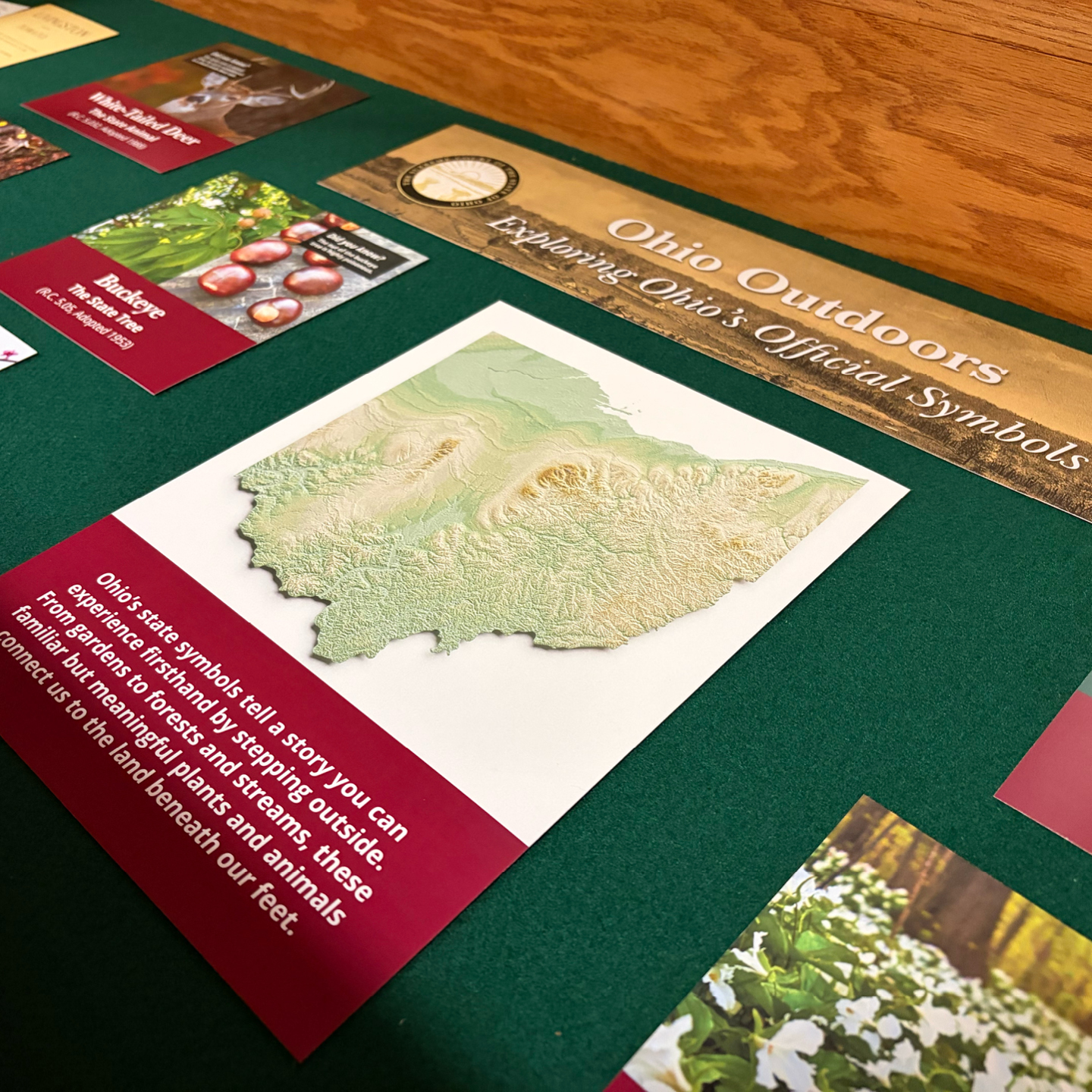
Throughout June, a new Supreme Court display explores the intersection of nature and laws.
From a president’s favorite flower to the successful lobbying by a 12-year-old interested in fossils, the state’s unique natural landscape is recognized in Ohio law. Features of Ohio nature have been assigned as official state symbols in the law for more than 100 years.
As part of Ohio’s celebration of the 250th anniversary of the United States, the state has chosen the great outdoors as its June focus, and the Supreme Court of Ohio is highlighting that theme with a display for visitors about the state symbols connecting nature to the law.
The path to becoming a state symbol travels through the General Assembly. To be formally recognized in Ohio, a proposed state symbol must go through the legislative process to become law. The entire fifth chapter of the Ohio Revised Code is devoted to state insignia, seals, and holidays.
Many Sources Inspire State Symbols
Some state symbols are selected for the historical significance they have to Ohio. The white-tailed deer, Ohio’s state animal, was adopted in 1988 due to its importance to the original settlers of Ohio. The state airplane, the Wright Flyer III, and state artifact, the Adena pipe, were chosen after successful arguments were made to the General Assembly, marking their place in history.
Other state symbols, such as the state flower and state fossil fish, had less obvious introductions to becoming law. Niles, Ohio-born President William McKinley was honored with the designation of the scarlet carnation, his favorite flower, as the state flower. A 12-year-old from Medina offered testimony supporting the fish Dunkleosteus terrelli to members of the Ohio Senate. With “Dunk” remains still being unearthed in northeast Ohio, lawmakers gave the species the title as the official state fossil fish.
Occasionally, new classifications are created to highlight Ohio-specific or native plants and animals. With the carnation already holding the title of state flower, the large white trillium was adopted as the state wildflower 83 years after the carnation. The wildflower was chosen because of its natural prevalence in every Ohio county. In the current General Assembly, House Bill 860, as introduced, would designate the zebra swallowtail as the state butterfly.
See Display in Person During Visit to Court
If you visit the Supreme Court, be sure to stop by the America250 display in the Grand Concourse to read more about these historic state symbols of nature.
Learn more about specific state symbols and plan your visit to the Court.
As America is preparing for its 250th birthday on July 4, 2026, the Supreme Court is celebrating the semiquincentennial with a yearlong celebration called “The Story of America” highlighting significant historical events. Beyond digital content, the celebration includes events and displays at the Court. The initiative aims to spark curiosity, enhance civic literacy, and honor key moments in American and Ohio history.