
Legal Legacy: School's Right to Limit Free Expression Upheld
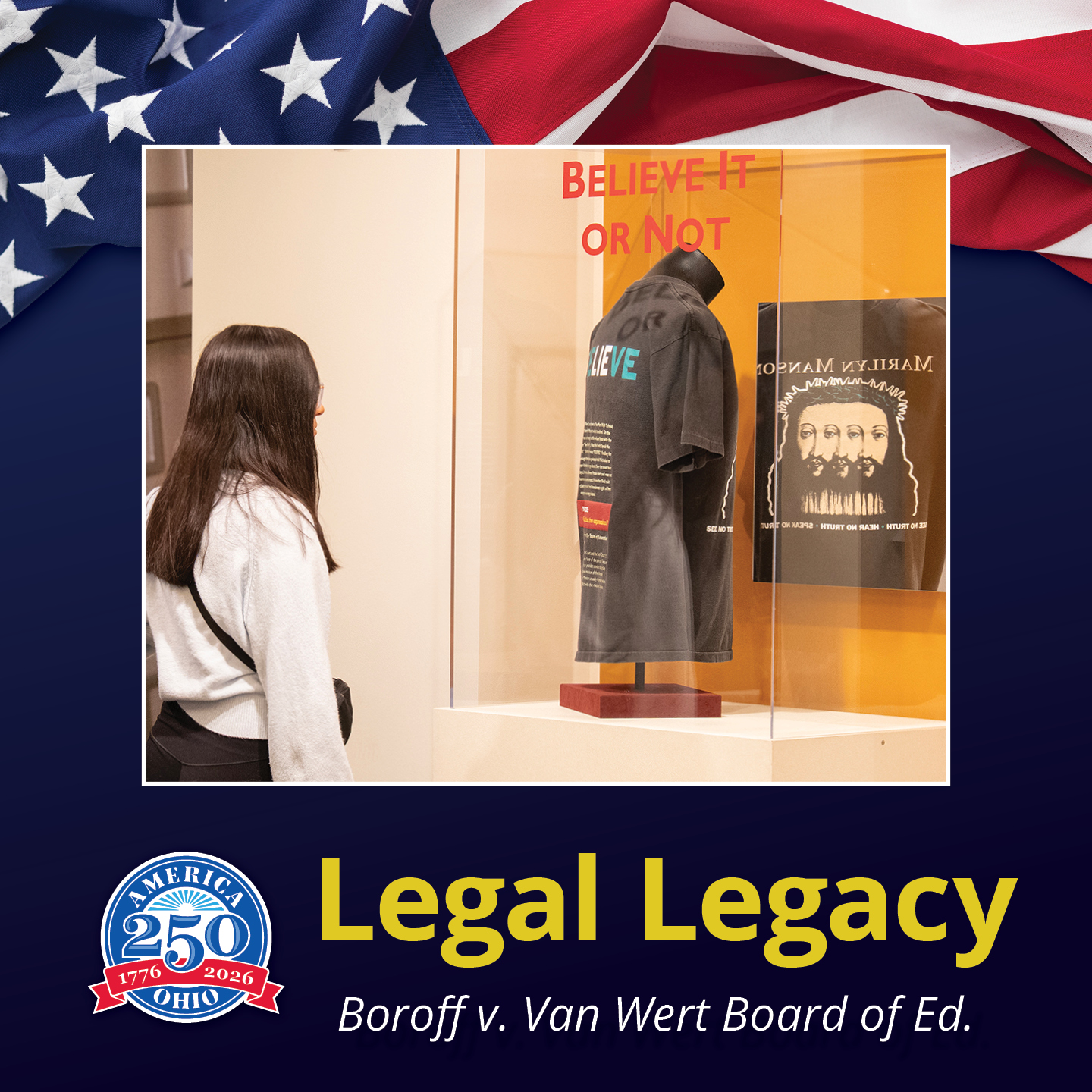
Twenty-six years ago, a federal appeals court ruled that an Ohio school’s prohibition of a Marilyn Manson band T-shirt didn’t violate a student’s constitutional rights.
Wearing a Marilyn Manson band T-shirt to class in August 1997, Van Wert High School senior Nicholas Boroff could reasonably have expected it to cause a stir. What he never could have predicted was that it would lead to a landmark federal ruling concerning schools' rights to limit the free expression of students.
By many standards, Boroff’s T-shirt would be considered provocative, if not profane. The front of Boroff's T-shirt depicted a three-faced Jesus, accompanied by the words “See No Truth. Hear No Truth. Speak No Truth.” It also prominently featured the name of the goth-rock group, which was the pseudonym of frontman Brian Warner, who sang about and was widely suspected to use illegal drugs. On the back of the shirt, the word “BELIEVE” was written out, with the letters “LIE” highlighted.
During this time, Van Wert High School’s dress code prohibited “clothing with offensive illustrations, drug, alcohol, or tobacco slogans.” An aide to the school principal determined that the shirt violated this policy and gave Boroff the choice to turn the shirt inside-out, change shirts, or leave and be considered truant. Boroff left school but returned resolute in his beliefs. For the next three school days, he wore different T-shirts that featured images of Manson in his signature ghastly makeup. Each day, Boroff was sent home and marked truant.
In response, Boroff’s mother filed a lawsuit in the U.S. District Court for the Northern District of Ohio in September 1997, alleging that the school had violated her son’s First Amendment right to free expression and Fourteenth Amendment right to due process. The federal district court ruled in favor of the school, and Boroff appealed to the Sixth U.S. Circuit Court of Appeals.
In the federal circuit court, the school contended that based on the U.S. Supreme Court decision in Bethel School District v. Fraser (1986), there is no First Amendment protection for offensive language at school. Citing Tinker v. Des Moines Independent Community School District (1969), also from the U.S. Supreme Court, the school argued it may regulate student expression if it is likely to cause disruption.
On July 26 in 2000, the Sixth Circuit ruled that the school hadn’t violated Boroff’s constitutional rights. The ruling stated that education officials can prohibit conduct that conflicts with the school's basic educational mission. Since the shirt promoted values inconsistent with the school’s educational mission, the administrators were permitted to forbid Boroff from wearing it, the Sixth Circuit found.
This case is one of several featured in the Visitor Education Center at the Thomas J. Moyer Ohio Judicial Center. Plan a visit to the Court or schedule a free tour by emailing courttours@sc.ohio.gov.
For more than a year, the Supreme Court has been celebrating the United States’ 250th birthday on July 4, 2026, with “The Story of America,” which highlights significant historical events. The celebration of the semiquincentennial extends beyond digital content to also include events and displays at the Court. The initiative aims to spark curiosity, enhance civic literacy, and honor key moments in American and Ohio history.