
Court Upholds Felony Murder Conviction for Driver Who Struck Firefighter Responding to Accident
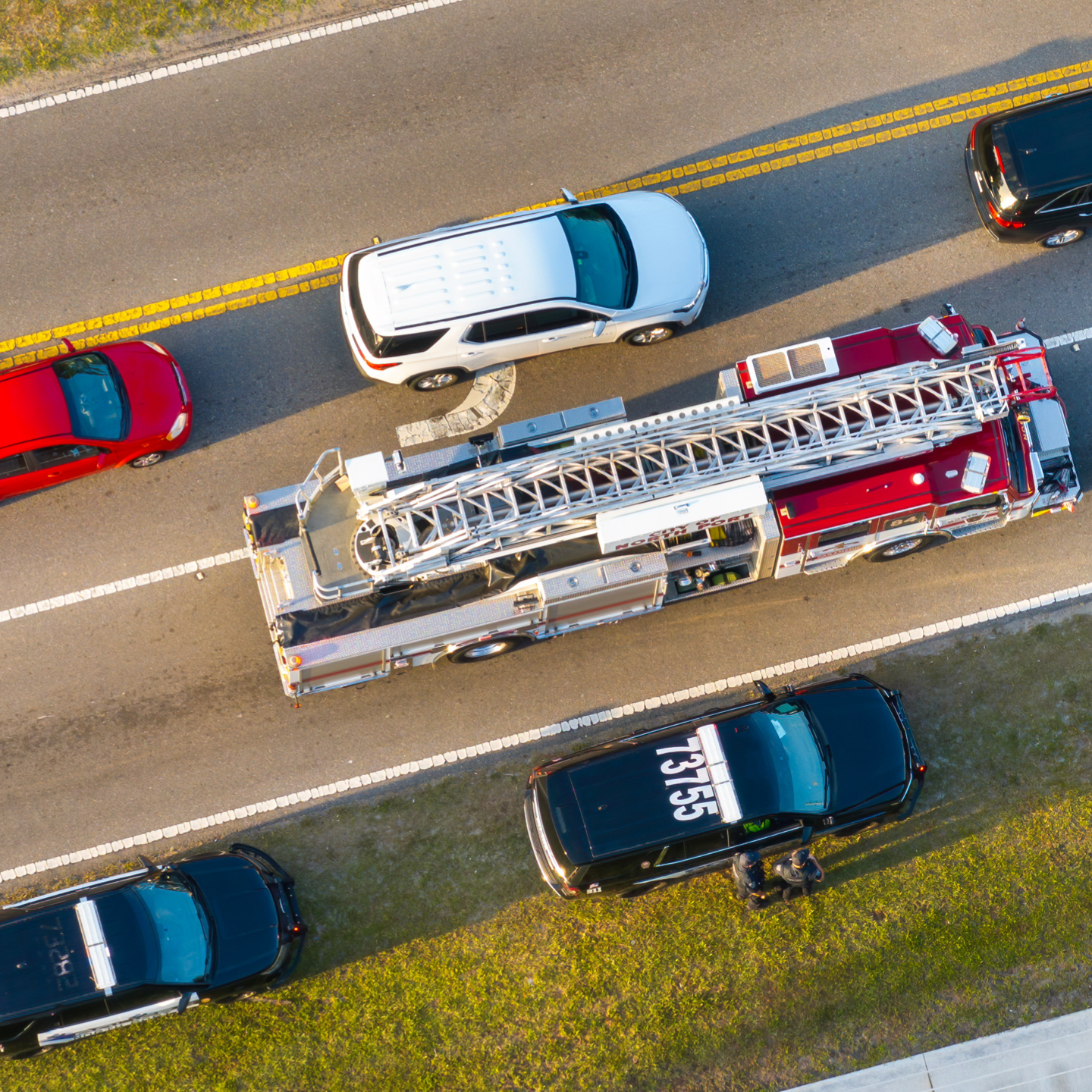
Court upholds felony conviction of driver who sped through an accident scene, hitting and killing a Cleveland firefighter.
A trial court had sufficient evidence to convict a driver of felony murder for speeding around heavy traffic and parked police vehicles and through an accident scene, which resulted in the driver hitting and killing a Cleveland firefighter on Interstate 90, the Supreme Court of Ohio ruled today.
In a unanimous decision, the Supreme Court reversed an Eighth District Court of Appeals ruling that had reduced Leander Bissell’s felony murder conviction to involuntary manslaughter. In a 2-1 decision, the appeals court ruled that the prosecution failed to prove Bissell acted “knowingly,” which is a requirement to ultimately convict him of felony murder. The Eighth District ruled his conduct was reckless, which permits an involuntary manslaughter conviction.
Writing for the Court, Justice Patrick F. Fischer stated that the Cuyahoga County Prosecutor’s Office only had to provide sufficient evidence that Bissell was “aware” that speeding around heavy traffic and parked police vehicles and through an accident scene on the highway in November 2022 would “probably” cause serious physical harm to first responder Johnny Tetrick. The trial court’s determination that Bissell’s conduct would probably lead to serious physical harm was supported by the evidence, he stated.
“Instead of proceeding with caution, Bissell swerved in between lanes, onto the shoulder of the road, and around four parked police vehicles, which were blocking the left two lanes of travel,” he wrote. “Considering the evidence in this case in the light most favorable to the State, sufficient evidence exists to establish that Bissell was aware his conduct would probably cause serious physical harm to a bystander or first responder like Tetrick for purposes of Bissell’s felony-murder conviction.”
Driver Weaved Through Parked Police Cars Before Speeding Through Accident Scene
Around 8:15 p.m., Tetrick and fellow Cleveland firefighters responded to a vehicle crash on I-90. A vehicle had flipped over and was on the left shoulder of the highway, blocking part of the far-left lane of the four-lane highway. Because the accident occurred near the border between Cleveland and the village of Bratenahl, an unusually large number of police officers responded.
Police officers parked several vehicles with lights flashing on the left two highway lanes to funnel traffic into the right two lanes and around the flipped vehicle. Traffic in the right lanes was moving very slowly through the accident scene.
Tetrick parked the fire truck just ahead of the flipped vehicle, and first responders exited the truck and began assessing the scene. A person involved in the flipped vehicle accident was sitting in the back of a pick-up truck parked on the right shoulder of the highway. Tetrick and another firefighter went to check on the person. Another firefighter testified at Bissell’s trial that police had stopped traffic in the right two lanes so that he and Tetrick could safely cross the roadway.
Once the two determined the person in the truck did not need medical aid, they began making their way from the right shoulder of the highway back across the two rights lanes, at which point traffic was moving very slowly. When Tetrick walked across the right two lanes, he bent down to pick up a piece of debris in the center left lane--one of the two lanes blocked off by police. Bissell veered from one of the right lanes into the center left lane and struck Tetrick. The impact threw Tetrick about 103 feet, and he died as a result.
Because Bissell did not stop at the scene, police viewed video taken from highway cameras to determine which vehicle struck Tetrick. Police located the vehicle parked near Bissell’s Cleveland apartment. Police found Bissell inside his apartment and arrested him.
Bissell was charged with felonious assault, felony murder, involuntary manslaughter, aggravated vehicular homicide, failure to comply with a police officer’s order, and failure to stop after an accident.
Bissell Challenged Conviction
Bissell opted for a bench trial, and the trial judge found Bissell guilty of all charges. After merging some of the offenses, the trial court sentenced Bissell to 15 years to life in prison for felony murder, one year for failure to stop after an accident, and a six-month concurrent term for failure to comply with an order or signal of a police officer, for a total prison sentence of 16 years to life. Bissell appealed his convictions to the Eighth District.
Bissell argued that to be convicted of felony murder, the prosecution had to prove he committed the underlying charge of felonious assault, which required the prosecution to prove Bissell acted “knowingly.” He maintained the state failed to prove he acted “knowingly,” because no evidence showed he saw Tetrick or anyone else in the roadway, and that police failed to warn that pedestrians or safety personnel would be crossing the highway. He asserted that, at most, his conduct was reckless.
In a split decision, the Eighth District agreed with Bissell and ruled that no evidence indicated he had seen Tetrick or that he deliberately aimed his car at Tetrick. Instead, the majority found that, despite the police presence and heavy traffic, his behavior was “a hallmark of reckless conduct.” The Eighth District modified the felony murder conviction and reduced the charge to involuntary manslaughter.
The dissenting judge found that speeding through an area of stopped traffic with a heavy first responder presence established that Bissell acted knowingly when he hit Tetrick because it was probable that his driving would cause serious physical harm.
The prosecutor appealed the decision to the Supreme Court.
Supreme Court Analyzed Felony Murder Requirements
Because Bissell challenged his conviction based on the sufficiency of the evidence against him, Justice Fischer explained the Court must determine “whether the evidence presented, when viewed in a light most favorable to the prosecution, would allow any rational trier of fact to find the essential elements of the crime beyond a reasonable doubt.”
A felony murder charge is based on causing a person’s death as a result of committing or attempting to commit a felony. Bissell was charged with felonious assault under R.C. 2903.11(A)(1) and R.C. 2903.11(A)(2), which provide that “no person shall knowingly” cause serious physical harm to another, or cause physical harm to another by means of a deadly weapon or dangerous ordinance, which includes a motor vehicle.
The law states that “a person acts knowingly, regardless of purpose, when the person is aware that the person’s conduct will probably cause a certain result or will probably be of a certain nature.”
The Eighth District ruled that Bissell did not act knowingly because it found knowing conduct means a person “acts with a degree of certainty in one’s intention that a result will occur.” This Court stated the Eighth District’s “reasoning is wrong” by requiring proof of “intention that a result will occur.”
The law states a “person acts knowingly regardless of purpose, when the person is aware that the person’s conduct will probably cause a certain result,” the opinion noted.
“Therefore, an offender’s purpose or intention to cause a result is not required when determining an offender’s knowledge, ‘only an awareness of the probable consequences of one’s action,’” the opinion stated.
The prosecution was required to show that Bissell’s conduct would probably cause a result, and that “probably” is defined as more reason for expectation or belief than not, the opinion explained.
The evidence showed Bissell weaving past the parked police vehicles, passing them on both the right and left. He was traveling about 49 mph when he hit Tetrick. Bissell did not apply his brakes or stop after hitting Tetrick.
Bissell argued that prosecutors failed to prove he saw Tetrick or even knew that a car accident occurred. He maintained that police did not warn drivers that first responders were on the roadway. He also said he had no warning or reason to suspect that Tetrick would cross from one side of the highway, where traffic was moving, to the other when the accident occurred. Bissell also argued that the highway camera video shows at least 28 other vehicles before him driving through the center left lane past the flipped vehicle.
The Court determined that while it is unclear whether Bissell saw Tetrick, he did see at least four parked police vehicles, which he swerved around. And while 28 other vehicles used the center left lane, Bissell conceded that none of them were traveling at the same high rate of speed as he was, and none of those vehicles struck anyone. The evidence was sufficient for the trial court to hold that Bissell acted knowingly because he was aware that his conduct would probably cause serious physical harm to a bystander or first responder at the scene, the Court concluded.
The Court remanded the case to the Eighth District for further proceedings.
2024-1770. State v. Bissell, Slip Opinion No. 2026-Ohio-1965.
 View oral argument video of this case.
Please note: Opinion summaries are prepared by the Office of Public Information for the general public and news media. Opinion summaries are not prepared for every opinion, but only for noteworthy cases. Opinion summaries are not to be considered as official headnotes or syllabi of court opinions. The full text of this and other court opinions are available online.
 PDF files may be viewed, printed, and searched using the free Acrobat® Reader
 Acrobat Reader is a trademark of Adobe Systems Incorporated.